
Cermonews #15 | Timetable Optimization in Public Transport

🚌 Hello from the 15th issue of Cermonews! 👋🏻
For fifteen issues now, we have been exploring key concepts in public transport planning together with their real-world operational implications and practical applications in the field. We are truly happy to see that this series has gradually become a resource that can be revisited and used as a reference for many topics. Thank you for the interest and engagement you have shown so far.
In this issue, we focus on a critical topic at the heart of public transport planning processes: Timetable Optimization.
Establishing a balanced, feasible, and sustainable service structure requires a perspective that goes beyond traditional planning approaches. In this issue, we explore the fundamental logic of timetable optimization, the operational consequences of poorly designed schedules, and how data-driven decision support systems can contribute to improving this process.
Throughout this newsletter, we will discuss:
What timetable optimization means in public transport,
The operational impact of a well-designed timetable,
Common challenges encountered in service planning,
And how Cermoni helps make this process more balanced and predictable.
As always, we will also ask you a few questions along the way to encourage different perspectives and share experiences across the sector.
Enjoy reading! 🚌
🧩 What is Timetable Optimization in Public Transport?
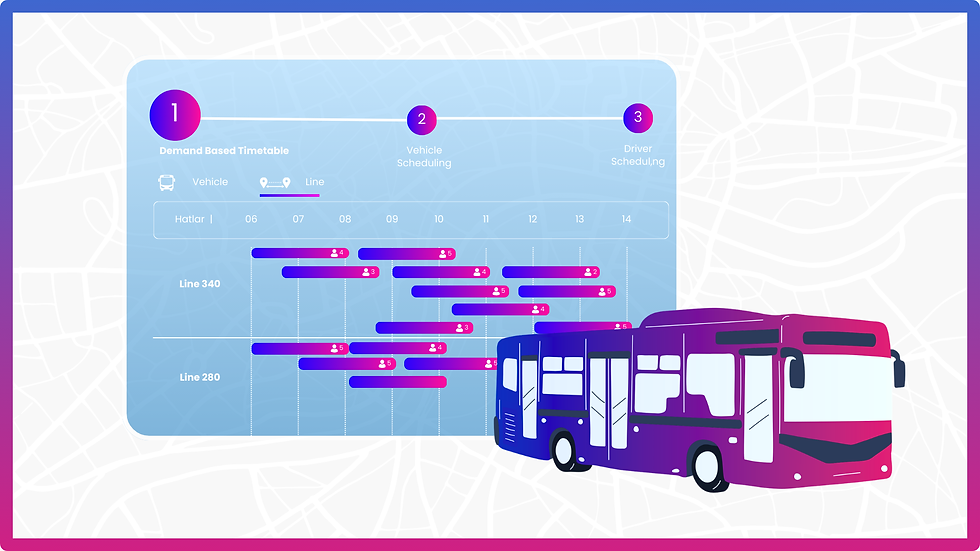
Timetable optimization in public transport refers to the planning process that determines when vehicles should operate on specific routes and how service frequencies should be distributed throughout the day in alignment with passenger demand patterns.
The main objective is to respond to passenger demand in a balanced way throughout service hours while managing the existing fleet and operational constraints as efficiently as possible.
This process goes beyond simply determining departure times. It also involves:
regulating service headways,
managing peak-hour demand,
maintaining load balance across routes,
and optimizing resource allocation.
A well-designed timetable enables the operation to function in a more predictable, balanced, and sustainable way, while preventing both unnecessary low-load trips and insufficient service capacity.
🔍 What Should Be Considered in Timetable Planning — and What Does a Well-Designed Schedule Change?
The main objective of timetable planning is to structure the service in a balanced way between passenger demand, operational realities, and resource constraints.
Key aspects to consider include:
Demand distribution throughout the day
Service headways
Route performance
Fleet constraints
Operational sustainability
A well-designed timetable can:
Improve service balance
Optimize resource utilization
Reduce disruptions and operational risks
Increase overall operational predictability
As a result, both operational performance and passenger experience improve directly.
⚠️ Common Challenges in Public Transport Timetable Planning
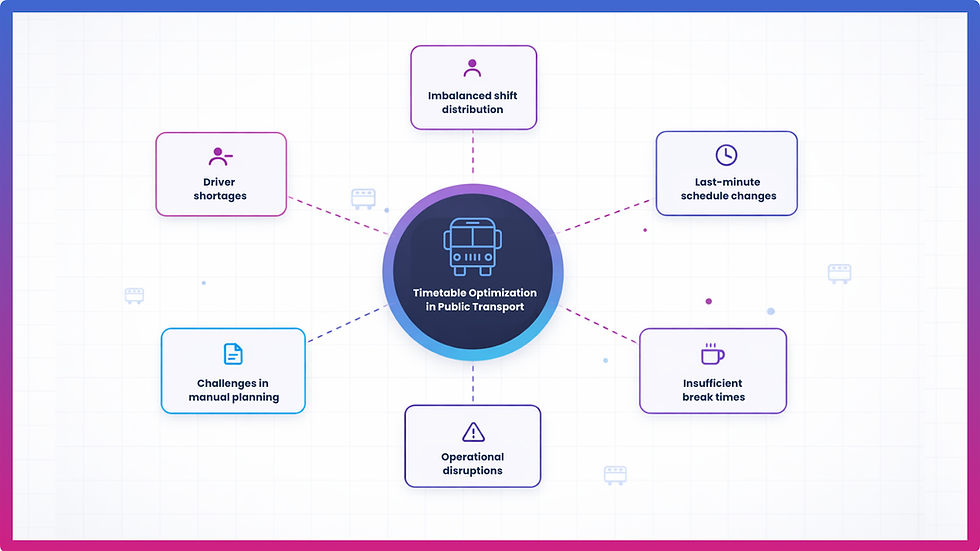
Timetable planning requires the simultaneous consideration of demand patterns, route characteristics, and operational constraints. Because of this complexity, several issues frequently arise in practice.
Some of the most common challenges include:
Service frequencies misaligned with demandIf daily demand patterns are not properly reflected, some time periods may experience excessive service while others fail to meet passenger demand.
Irregular headways (headway instability)
When vehicles do not operate at predictable intervals, this can lead to bus bunching and service imbalance.
Peak-hour capacity imbalance
If capacity falls short during peak periods, overcrowding and service quality issues may occur.
Ignoring fleet constraints
Schedules that do not properly consider available fleet size and vehicle capacity may lead to operational disruptions.
Inconsistencies caused by manual planning
Excel-based planning approaches become increasingly error-prone and difficult to manage as operational complexity grows.
Over time, these issues can significantly affect both operational performance and passenger satisfaction. Therefore, it is critical to regularly review timetables and improve them using data-driven approaches.
What do you think is the most challenging aspect of timetable planning?
Managing demand fluctuations effectively
Determining balanced service frequencies
Planning in line with fleet constraints
Reducing service irregularities and disruption risks
🚍 Timetable Optimization with Cermoni - Right Time, Right Frequency, Right Vehicle — Is It Possible?
Cermoni approaches timetable planning not merely as a process of defining departure times, but as a balance between passenger demand and operational capacity.
By analyzing passenger mobility patterns, load factors, and route-based demand variations, service frequencies are adjusted accordingly.
This approach enables:
Service frequencies better aligned with demand patterns
Reduced overcrowding during peak hours
Minimization of unnecessary low-occupancy trips
A more balanced and predictable operational structure
As a result, the timetable evolves from a static schedule into a demand-responsive service framework.
🎥 New Cermopedia Episode: What Is Timetable Optimization in Public Transport?
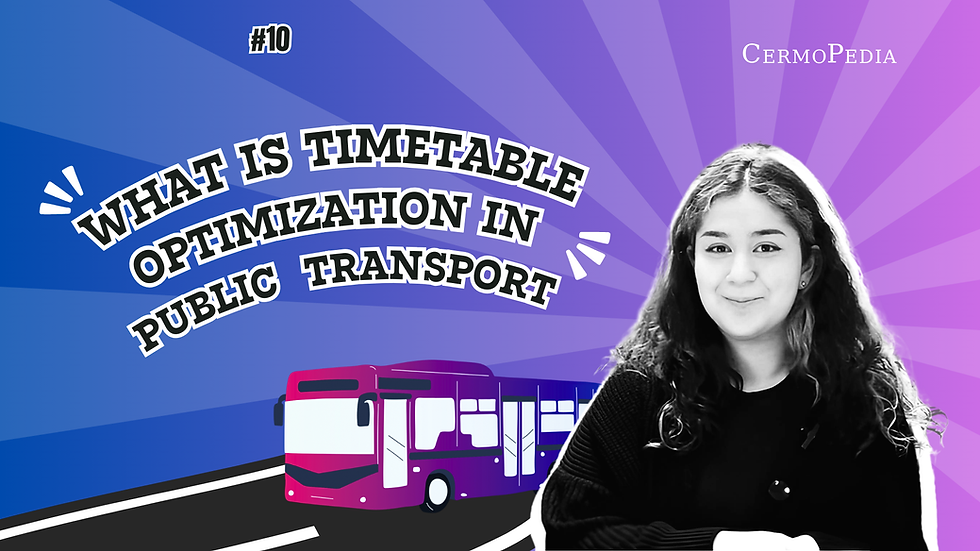
In the latest episode of Cermopedia, we focus on the topic of Public Transport Timetables.
In this short and easy-to-follow episode, we explore questions such as:
What is timetable planning and why is it important in public transport?
What are the limitations of traditional planning approaches?
How can more efficient schedules be created using demand data?
What capabilities does Cermoni provide in this process?
In this 3-minute video, we highlight why a well-designed timetable is essential not only for improving travel times but also for enabling operators to use their resources more efficiently.
👉 Click to watch
Stay tuned for upcoming episodes! 🎥📚
Follow for more! 🎥📚
📊 How does your organization manage timetable planning?
Based on operational experience and field observations
Using demand data and performance analysis
Using a digital planning or optimization tool
📰 News from Us
🌐 Formalizing Our Digital Twin Training Collaboration with EGO

Within the scope of the Digital Twin–focused training project supported by Ankara Development Agency, we have formalized our collaboration with EGO General Directorate.
As part of this initiative, a “Digital Twin Awareness and Technical Capacity Development Training Program” will be delivered to EGO teams.
🚀 We Completed Our 2026 Bootcamp Program

As the Parabol team, we came together during our 2026 Bootcamp to review our strategic priorities, team goals, and shared ambitions.
During two days of intensive sessions, we had the opportunity to transform our vision for the coming period into concrete roadmaps.
In the upcoming year, we will continue working toward innovation, impact, and sustainable growth for both Parabol and the mobility ecosystem.
🚦 Safely Project Successfully Completed with Measurable Results

The Safely Project, supported by EIT Urban Mobility, has been successfully completed with tangible and measurable outcomes in Konya and Sarajevo.
The project focused on transforming urban mobility data into traffic safety decision-making tools.
The results clearly demonstrated that data-driven approaches can generate real and observable improvements in urban traffic safety.
Safely has shown that when traffic safety is measured, monitored, and managed through data, cities can achieve meaningful improvements.
👉 Click here for project details and survey results.
🚍 How Would Timetable Optimization Change Public Transport in Your City?
Every timetable decision — shaped by demand fluctuations, peak-hour pressures, and fleet constraints — produces visible results in real-world operations.
What are the most influential factors in timetable planning in your city?
📩 If you would like to share your observations and experiences, we would be happy to hear from you.
You can also read this newsletter via the link and share it with colleagues who might find it interesting.
See you in the next issue! 👋
If you are interested in reading other editions of our newsletter;


Comments