
Cermonews #14 | Shift Planning in Public Transportation (Roster)


🚌 Hello from the 14th edition of Cermonews! 👋🏻
From the outside, public transport often appears as nothing more than vehicles moving along scheduled routes. Yet behind this flow lies an intricate system where numerous variables must be coordinated simultaneously—from driver rest requirements and fair duty allocation to service continuity and regulatory constraints.
Considering fluctuating daily demand, peak hours, break requirements and the physical limits of the fleet, designing a plan that is fair for drivers, operationally sustainable and seamless for passengers can no longer be accomplished with Excel spreadsheets alone.
In this edition, we focus on a process that is often invisible but directly affects both employee well-being and service quality in the field: Roster Planning, known among planners as “kafa kâğıdı”.
Throughout the newsletter, we will explore:
What roster (shift) planning means in public transport
How an effective roster changes both operational performance and driver experience
Common issues encountered in shift planning
And how Cermoni makes the entire process more transparent, fair and manageable
As always, you will also find our Updates from Us and Behind the Scenes sections. We will also ask you a few questions to better understand how roster planning is approached in different cities.
Enjoy the read! 🚌
🧩 What Is Roster Planning in Public Transport?
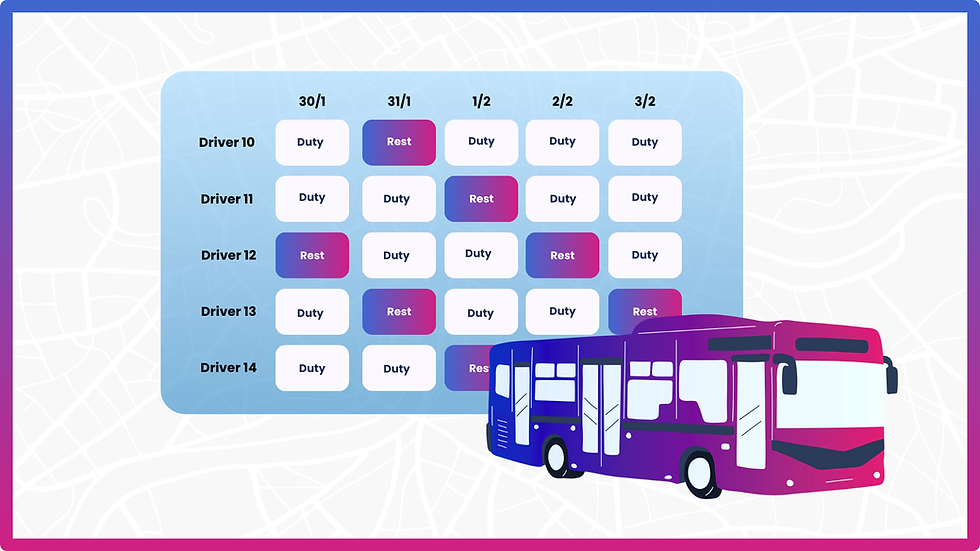
Roster planning determines the days, hours and duties that each driver will perform. Conducted after timetable preparation and vehicle–driver assignment, this process brings together working hours, duty blocks, rest-break arrangements, standby driver needs and driver–vehicle pairings.
Its main goal is to create a working structure that is compliant with labour regulations, fairly distributed and operationally viable. As a result, both the service flow and drivers’ schedules become structured, balanced and feasible.
Public transport operators may use different roster types—fixed, rotating or split shifts—depending on organizational structure and route-specific demand characteristics.
🔍 What Should Be Considered in Roster Planning & What Does a Good Roster Change?
The aim is to design a driver schedule that meets legal requirements, ensures fairness and supports operational continuity. Key considerations include:
Compliance with working-time regulations: Daily working hours, break intervals and weekly rest days must meet legal standards.
Fair and balanced distribution: Morning, evening and high-demand duties should be rotated fairly among drivers.
Realistic break and turnaround times: Rest breaks must reflect route length, traffic conditions and headways.
Standby driver availability: Operators must define sufficient flexibility for illness, leave or unexpected operational changes.
Deadheading and layover optimization: Reducing long layovers and unnecessary non-revenue movements increases operational feasibility.
A well-designed roster:
Balances driver workload
Reduces delays and disruptions
Ensures a more stable and predictable service throughout the day
This strengthens both driver satisfaction and the passenger experience.
⚠️ Common Challenges in Public Transport Roster Planning

Managing multiple constraints simultaneously can introduce several difficulties:
Unrealistic duty planning: Route characteristics or actual field conditions may be overlooked, making schedules hard to follow.
Uneven workload distribution: Inequitable assignment of peak or challenging duties can create dissatisfaction.
Inadequate break planning: Misaligned break times can disrupt both working conditions and service continuity.
Insufficient standby planning: Lack of flexibility for sudden absences increases disruption risk.
Manual planning errors: Spreadsheet-based processes often lead to inconsistencies and make it difficult to manage complex constraints.
Over time, these issues can reduce driver satisfaction and service quality, underscoring the importance of keeping the roster regularly updated and optimized.
How do you handle roster planning?
Using Excel or manual schedules
Using a digital planning tool
🚍 Roster Planning with Cermoni — Can Fairness, Break Management and Efficiency Coexist?
Cermoni treats roster planning not merely as timetable creation but as an integral part of the entire public transport operation. Its purpose is to optimize schedules, vehicle allocation and driver duties holistically, creating a fair and sustainable working structure.
In Cermoni, roster planning is the final step of the planning chain. After timetable and vehicle–driver matching are completed, the system generates the most balanced and feasible roster within defined constraints. Break times, duty allocations, duty transitions and standby requirements are evaluated together, ensuring:
Balanced workload
Predictable operations
Fair and transparent task distribution
With its optimization-based approach, Cermoni shifts roster planning from “who works when” to a framework centred on fairness, service continuity and efficiency. Balanced distribution of intensive duties, route-appropriate break scheduling and minimizing unnecessary waiting times are natural outcomes—improving both driver satisfaction and operational performance.
Without such an integrated structure:
Duty transitions would not align with the timetable
Irregular waiting times and delays would increase
Some drivers would be overloaded while others receive lighter duties
Manual Excel-based processes would increase the risk of errors
The result?
A seamlessly managed roster where break times, duty distribution and work patterns are integrated; a fair and transparent structure for drivers; a more reliable experience for passengers; and a more sustainable operation for operators.
🎥 New Cermopedia Episode: What Is Roster Planning in Public Transport?
In the latest Cermopedia episode, we explore:
What roster planning is and why it is critical within operations
How roster creation follows timetable and crew scheduling
How break times and duty allocations are balanced
When fixed, rotating or split shifts should be used
Challenges in manual planning and benefits of digitalization
In just 2.5 minutes, discover how one of the most essential yet invisible steps in public transport planning is shaped.
Follow for more! 🎥📚
What do you think is the biggest challenge in roster planning?
Distributing duties and workload fairly
Planning break and turnaround times in line with field condi
Ensuring compliance with labour regulations
Managing sudden changes and standby driver requirements
📰 News from Us
🚶♀️ We Attended Tomorrow.Mobility & Smart City Expo World Congress 2025!

Tomorrow.Mobility and Smart City Expo World Congress 2025, held in Barcelona, once again brought together numerous stakeholders working to make cities safer, smarter and more sustainable. As Parabol, we actively participated both on stage and within the exhibition area throughout the event.
🎤 Our Marketing Director, Tuğçe Işık, delivered a presentation titled “Enhancing Road Safety for Vulnerable Road Users with Smart Analytics,” sharing the impact we achieved for vulnerable road users in Konya and Sarajevo through the Safely project. She also took part in the BABLE Urban Shark Tank session within the Urban Impact Lab, where she presented our insights on resilient and electric public transport systems in earthquake-affected cities.
📍 Throughout the event, we engaged with visitors at our booth in the Tomorrow.Mobility area, showcasing our data-driven public transport solutions and our road safety approach.
We extend our gratitude to all stakeholders who visited our booth, attended our presentations, and contributed to the exchange of knowledge during the event. 🌍🙌
📍 Safely Road Safety Project Field Visit in Sarajevo

As part of the Safely project, our on-site visit held on 11–12 November 2025 in Sarajevo was successfully completed. Over the course of two days, we examined the current mobility and road safety conditions and held extensive discussions with local stakeholders.
📍 During the visit:
We attended presentations on Sarajevo’s road safety strategy and high-risk location analyses,
Shared Parabol’s traffic safety analyses conducted in Sarajevo and the contributions of Konya Metropolitan Municipality,
Conducted field inspections at high-accident-density locations identified through Safely,
Observed sustainable mobility practices implemented in the city.
The Safely project continues to advance road safety for vulnerable road users through close collaboration with all stakeholders. 🌍🤝
🚌 We Joined the “Smart Systems and Future Vision” Panel in Bursa

We participated in the Smart Systems and Future Vision panel organized by the Chamber of Survey and Cadastre Engineers (HKMO) Bursa Branch, where we presented our insights on the data-driven transformation of urban mobility.
🎤 During the panel, our Marketing Director Tuğçe Işık delivered a comprehensive presentation titled “Decision-Support Systems in Mobility Management and Demand-Responsive Public Transport.” She provided a broad perspective spanning İstanbul and İzmir’s SUMP (SKUP) studies and demand-responsive planning examples from Bursa.
Throughout the event, we discussed how big data is used in mobility-related decision-making processes and evaluated how methods developed for traffic safety and multimodal mobility generate tangible impact in cities.
We continue to contribute to the mobility vision of cities. 🚀
Behind the Scenes 🙌🏻
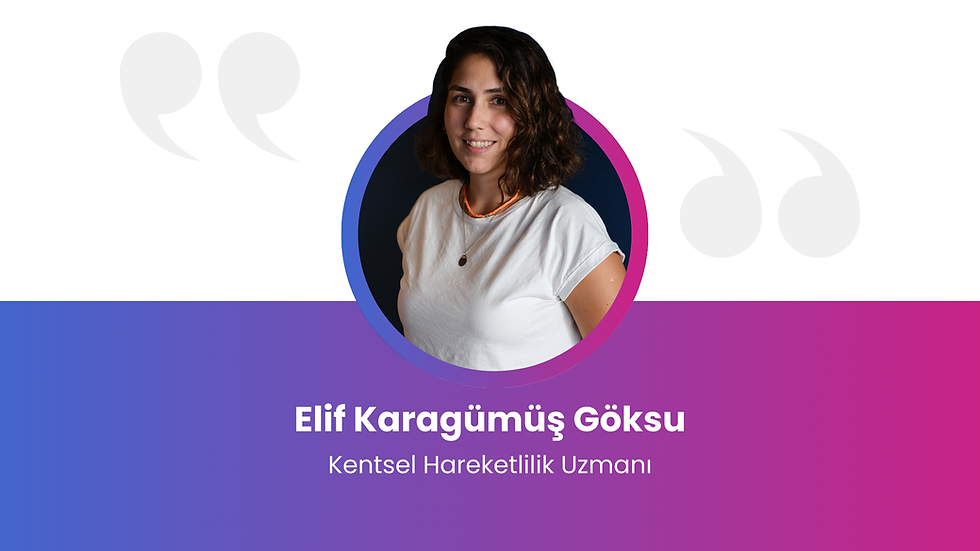
In each edition, we introduce you to the experts behind Parabol and bring you closer to the team contributing to the development of Cermoni.
Our guest in this issue is Elif Karagümüş Göksu, our Urban Mobility Specialist, who analyzes on-the-ground needs in the planning projects we conduct with cities and helps shape accurate, data-driven solutions.
"What I enjoy most in my role as an Urban Mobility Specialist at Parabol is witnessing Cermoni make a real impact in cities. Understanding how public transport routes operate, what drivers and passengers experience, and where cities struggle—and turning these observations into solutions through Cermoni—is both exciting and meaningful for me. Every day we work for a different city; in one place we relieve a congested route, in another we design a more equitable driver schedule, and in another we help shorten people’s travel times. Seeing that Cermoni truly works in the field, that it makes municipal teams’ jobs easier and contributes—directly or indirectly—to passengers is the most motivating part of my work. What I love most is feeling that what we do truly touches the city. I always feel like I’m out in the field: speaking with municipalities, operators and field teams, listening to their needs first-hand and transforming them into the right solutions within Cermoni. I believe a good public transport system is not just about numbers; small but effective touches that improve daily life matter enormously. And that is exactly where Cermoni’s strength comes from. Every project teaches me something new, and being able to say ‘yes, this really helped this city’ after each solution is incredibly fulfilling. Contributing to cities becoming smarter, more accessible and more organized—that is the best part of my job.”
🚍 What Would Better Roster Planning Change in Your City?
Providing fair, sustainable and uninterrupted public transport requires not only timetable planning but also effective scheduling of driver duties, break times and task allocation.
In this issue, we discussed what roster planning is, how it affects operational performance, and how Cermoni supports a more balanced and manageable structure.
👉 What do you think would change in your city if a more balanced and fair roster system were implemented?
We welcome your observations, suggestions and challenges.
You can also read this newsletter via the link and share it with anyone who may be interested.
See you in the next edition! 👋
We always look forward to your feedback. 🙌
If you are interested in reading other editions of our newsletter;


Comments