
Cermonews #12 | Public Transport Occupancy Rate


Welcome to the 12th edition of Cermonews! 👋🏻 👐🏻
When it comes to evaluating efficiency and service quality in public transport, one of the most critical indicators is occupancy.
If a vehicle runs under capacity, it means wasted resources; if it’s overcrowded, it results in loss of comfort—and sometimes even safety risks. But what exactly does occupancy mean? How is it measured? How can it be managed?
In this edition, we explore the concept of occupancy from every angle, from data-driven measurement methods to strategies that optimize passenger loads. We’ll also share how we at Parabol work with occupancy data through Cermoni, and how we integrate it into planning processes.
As always, you’ll also find our regular sections: News from Us, Cermopedia, and Behind the Scenes. 📊🚌
🎯 What is Occupancy and Why Does It Matter?
A healthy and efficient public transport system relies on many operational metrics—and one of the most important is the occupancy rate.
Occupancy refers to the number of passengers in a vehicle at a given moment or over a specific time period. This figure can be measured in real time (e.g., passengers currently on board) or as an average over a time range (e.g., average passenger count between 07:00 and 09:00).
On its own, the number is not meaningful—it gains value when compared to the vehicle’s capacity:
🧮 Occupancy Rate (%) = (Number of Passengers on Board / Vehicle Capacity) × 100
This indicator is a key measure of how efficiently a public transport system is operating. It is also directly tied to service quality, which is defined by factors such as comfort, accessibility, and reliability. Occupancy is one of the main variables shaping the passenger experience.
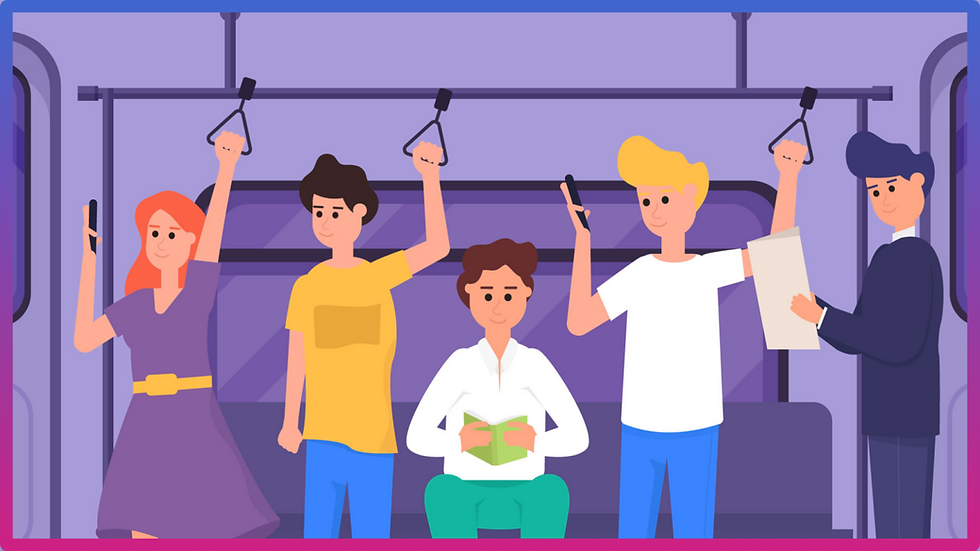
📊 Typical occupancy ranges can be classified as:
0–40% → Low occupancy, low efficiency
40–60% → Acceptable level
60–80% → Optimal balance: efficient and comfortable
80–100% → High occupancy, decreasing comfort
100%+ → Overcrowding, service crisis
For most cities, the optimal service level falls within 60–80% occupancy. Going beyond this range compromises comfort and lowers passenger satisfaction. This is why occupancy is not just a number—it is a key metric that defines service quality.
📏 How is Occupancy Measured? And Why Measure It?
Knowing how many passengers are on board a public transport vehicle is crucial for planning and improving the system. This information is not gathered through simple observation—it must be collected and processed using data-driven methods.
The core requirement for calculating occupancy is boarding and alighting data. With these, it is possible to track how many passengers board and leave the vehicle at each stop—allowing us to monitor the number of passengers on board at any given moment.
Passenger counts can be obtained through several technologies:
🎥 Onboard cameras with image processing to detect the number of passengers in the vehicle
🚪 Platform or door sensors / turnstiles to count boarding and alighting movements
💳 Smart card / ticketing systems, which provide detailed boarding data

However, these methods have limitations. In most cities, alighting data is either not collected at all or is available only in a very limited form. This makes it challenging to accurately calculate occupancy.
🎯 So, what happens in that case?
This is where occupancy detection algorithms come into play. Even with incomplete datasets, statistical modelling and data analysis techniques can estimate where passengers likely alighted. As a result, near-accurate occupancy values can be calculated despite missing data.
🔍 In short: Measuring occupancy is not just about counting—it’s about interpreting the data. With the right estimation techniques, both real-time peaks and long-term patterns can be identified—laying the foundation for smarter, evidence-based public transport planning.
📊 We Measured the Data… Now What?
Occupancy data is a powerful tool for understanding how a city’s public transport network is performing. But its true value lies not only in showing the current state—it becomes essential when it serves as the foundation for decisions that make the system more efficient and balanced.
Here’s what can be done with occupancy data:
🚍 Analyse service levels: Some routes may operate far below capacity, while others may be heavily overloaded.
In the morning peak, a certain route may run at maximum capacity on every trip
At midday, the same route might operate at half capacity Identifying these variations allows operators to add extra trips during peak times and reduce services during off-peak hours.

⚖ Balance resource use:
Underloaded vehicles → wasted fuel, maintenance, and staff time
Overcrowded vehicles → passenger dissatisfaction and safety risks
Occupancy data reveals these imbalances, enabling targeted adjustments to restore balance.
📍 Understand urban mobility patterns: This data helps build a broader picture of the city’s travel behaviour:
Which stops see the most traffic at specific times of day
Which routes are most preferred at which hours
These insights are evidence-based, allowing for precise and measurable answers.
🧠 Support intuition with data: Public transport staff and local residents may have a sense of these trends, but:
Intuition can’t be measured
It can’t be compared objectively
It doesn’t form a solid base for planning Data-backed analysis ensures that optimisation is based on reality, not guesswork—helping to plan not only for today but also for the future.
🧠 How We Manage Occupancy with Cermoni
Within Cermoni, we’ve developed an occupancy detection algorithm that uses boarding data—the smart card validation records from public transport vehicles—to estimate passenger loads.
With this algorithm, we can calculate the hourly peak occupancy for each route and direction. This allows us to predict exactly when, where, and in which direction passenger volumes will be highest during the day.
This information plays a critical role in optimising service timetables. For example:
In the mornings, routes heading toward the city centre may reach their highest occupancy levels
In the evenings, the same pattern often occurs in the reverse direction
By aligning vehicle allocation and trip frequency with these patterns, we can:
Increase passenger comfort during peak demand
Avoid unnecessary capacity use during off-peak periods
And we don’t stop there. We also perform date-based analyses to capture special circumstances, such as:
Increased demand on routes to shopping districts before public holidays
📌 Seasonal shifts in demand toward coastal areas during summer months

These insights allow us to design a more efficient, higher-quality system right from the start of the planning phase. Timetable optimisation directly influences vehicle and driver assignments, which in turn impacts driver schedules, shift durations, and duty rosters.
🔁 The result: When this chain of decisions is put into action in the field, it becomes possible to balance both passenger satisfaction and resource efficiency.
📰 News from Us
📢 Renewable Energy in Public Transport – Featured in Cermotalks

In the latest episode of our Cermotalks series, we focused on the relationship between renewable energy and public transport. 💨⚡
With the participation of Mehmet Akif Erdoğan, Deputy General Manager of Kayseri Ulaşım A.Ş., the session explored the Kayseri Model—Turkey’s first public transport system powered by wind energy—along with its approach to energy efficiency, electric bus fleet operations, and sustainability initiatives.
🎙 We extend our sincere thanks to Mr. Mehmet Akif Erdoğan for his valuable contributions.
⚡ High-Performance Computing in Public Transport Data Processing – at METU

Our teammate Egemen Can Ökten recently delivered a presentation at the EUMaster4HPC Summer School 2025, hosted by Middle East Technical University (METU). 👏
📌 In his talk, “High-Performance Mobility Analysis with HPC: Parabol & TRUBA Case Study”, he discussed the role of High-Performance Computing (HPC) in processing large-scale public transport datasets.
🚍 The presentation showcased:
Our decision support platform, Cermoni
Our Spark-based data processing infrastructure
Scalable analysis methods powered by the TRUBA supercomputer
🔍 This approach enables public institutions to produce faster, scalable, and data-driven solutions in transport planning and analysis.
We thank the EUMaster4HPC team for organising the event and METU for hosting us!
🙌🏻 Behind the Scenes
In every edition, we introduce you to one of our team members—bringing you closer to the people behind innovative work in public transport.
In this issue, meet Tuğçe Işık, our Marketing Director, who leads Cermoni’s marketing efforts and plays an active role in connecting our public transport solutions with cities.

"Over my 8+ years at Parabol, I’ve come to see Cermoni as one of the most tangible examples of the impact we create. Understanding the challenges faced in public transport, delivering data-driven solutions, and contributing to making it the first choice for urban mobility through digitalisation is something I deeply value. As Marketing Director, my greatest motivation is engaging with the people who work in this sector—understanding their needs and addressing them with the solutions we’ve developed. To me, Cermoni is no longer just a product; it has evolved into an ecosystem. Together with our users, partners, the content we produce, the international projects we bring, and our strong network connections (EIT UM, UITP, and more), we are building and growing a vibrant community every single day."
🚍 Some buses are packed—so why are others still running empty?
In your city, do public transport vehicles sometimes run over capacity while others operate nearly empty?
It’s possible to manage occupancy rates using data-driven planning.
Would you like to see a system where services are scheduled more evenly?
We believe this is a question worth exploring together. Contact us to start the conversation.
🎯 As Cermonews readers, we’d love to hear your observations, needs, or inspiring practices from the field.
Thank you in advance for sharing! 🙌
You can also read this newsletter online via the link and share it with anyone who might find it useful.
See you in the next edition. 👋


Comments