

Electric Public Transport Planning for Kaaba Visits During Ramadan
.png)
The Challenge
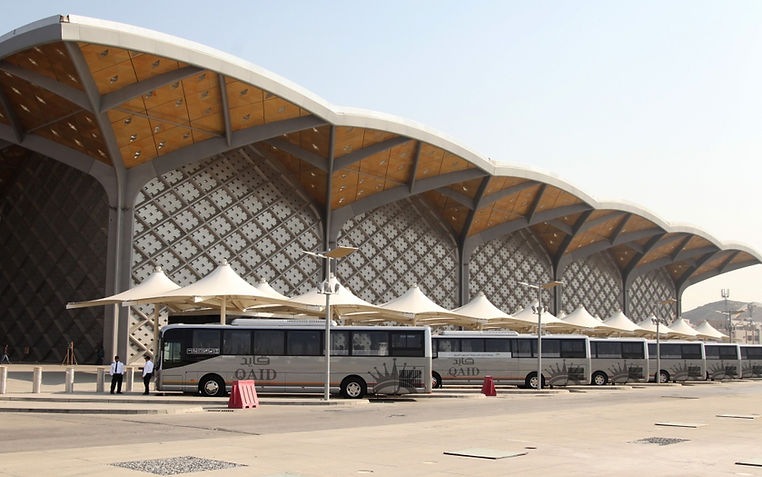
During Ramadan, mobility in Makkah defies conventional urban transport patterns. The Al Haramain High-Speed Rail Station generates concentrated waves of passengers throughout the day and night, all needing reliable last-mile connection to Masjid al-Haram.
Without a coordinated shuttle system, high-volume train arrivals lead to passenger accumulation, rising wait times, and localized congestion. Each train carries up to 417 passengers — and multiple trains can arrive within minutes of each other.
Ramadan demand in Makkah has no conventional morning peak. Instead, service intensity concentrates in late-night windows (00:00–04:00) and afternoon–evening periods (14:00–20:00) — making standard transit planning models insufficient.
Making an impact
To address these challenges, Cermoni was implemented to develop a full operational framework for the MASAR Shuttle Bus Service — a first-mile and last-mile connection between Al Haramain Train Station and Masjid al-Haram during Ramadan. In partnership with SAR (Saudi Arabia Railways), this project brought a structured, data-driven approach to one of the most complex seasonal mobility environments in the world.
The available fleet of 12 buses — including 4 electric vehicles with simultaneous charging constraints — needed to be deployed efficiently across shifting demand patterns throughout the day. The goal was to build a complete operational system that would:
-
Maximize passenger throughput during Ramadan while respecting fleet and infrastructure constraints
-
Integrate EV charging cycles directly into vehicle rotation planning to prevent capacity loss at peak hours
-
Provide scalable, scenario-based deployment so operations can adapt to real demand without replanning from scratch
-
Ensure full compliance with KSA Ramadan labor regulations across driver scheduling and rostering
-
Maintain 24/7 service continuity synchronized with train arrivals and departures
With Cermoni's planning and optimization engine, train arrival and departure patterns across the full Ramadan period were analyzed to identify demand concentration windows, define headway structures, and build three fully optimized operational scenarios — each with integrated timetabling, vehicle assignment, EV charging rotation, and driver rostering.
10,650
Passengers served per day (Scenario 2)
213
Shuttle trips per day at peak deployment
7/24
Continuous operations, train-synchronized
3
Demand scenarios fully modeled and optimized
The Solution
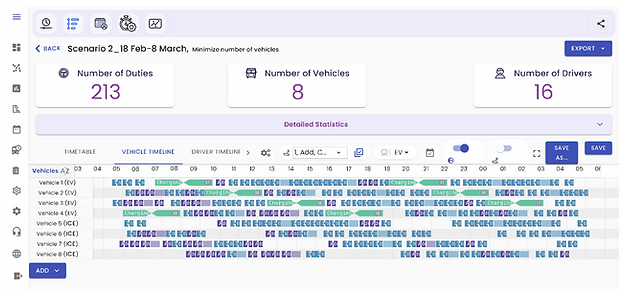
Using Cermoni, three operational scenarios were modeled — each with full timetabling, vehicle assignment, EV charging rotation, and driver rostering. Electric vehicle charging constraints (max 2 buses simultaneously, 3-hour cycles) were integrated directly into the vehicle rotation logic to prevent capacity loss during peak windows.
-
Scenario 1:
106 trips/day = 10–15% demand capture · 4 EV buses · up to 5,300 passengers/day
-
Scenario 2:
213 trips/day = 20–25% demand capture · 8 vehicles · up to 10,650 passengers/day
-
Scenario 3:
315 trips/day = Full fleet · 75–80% theoretical demand coverage
Driver rostering was structured around KSA Ramadan labor regulations — 6-hour working days, max 3 hours overtime, 3-shift rotation — with 20 drivers required for full-scale deployment across Scenario 2.
Lesson Learnt
-
Planning for context, not convention: Ramadan mobility in Makkah follows patterns that standard transit models cannot anticipate. Building the schedule around actual train arrival data and religious demand cycles — rather than conventional peak-hour assumptions — was what made reliable operations possible.
-
Making constraints part of the plan from day one: EV charging limitations, KSA labor regulations, and crowd dynamics at high-density stops were integrated into the planning model from the start — not treated as exceptions. This ensured that the operational framework held up under real conditions.
-
Scenario-based planning as a tool for resilience: Modeling three demand scenarios in parallel gave SAR the flexibility to scale operations up or down based on actual passenger volumes without rebuilding the plan from scratch. Adaptability was designed in, not added later.
-
First-mile and last-mile connectivity as a system, not a service: The MASAR project demonstrated that connecting a high-speed rail station to a major destination requires end-to-end thinking — timetabling, fleet, drivers, crowd flow, and ticketing all need to work as one coherent system to deliver a reliable passenger experience.
